You have a we-we problem on LinkedIn.
Your LinkedIn Content Isn’t Failing Because of the Algorithm
It’s Failing Because You’re Talking About Yourself
Let’s be honest. Most B2B LinkedIn content reads like a company talking to itself.
Product updates. Thought leadership that says nothing. Polished posts that sound smart but don’t move anything. And the default blame goes to the algorithm. (also, the algo changed BIG time in Jan 2026 to 360BREW, read on…)
It’s not the algorithm. It’s that your buyer doesn’t care.
They’re not on LinkedIn looking for content. They’re trying to make decisions under pressure. Capital is tight. Expectations are high. The risk of making a wrong decision includes the impact on their personal brand. If your post doesn’t meet them there, it disappears.
The Part No One Wants to Say Out Loud
The LinkedIn algorithm is not (that) mysterious.
It rewards two things:
Clarity of topic
Consistency of perspective
That’s it.
If your content is scattered, vague, or trying to say five things at once, the algorithm can’t place you. And if the algorithm can’t place you, your buyers never see you.
So this isn’t about “writing better posts.”
It’s about writing in a way that both the algorithm and your buyer can understand instantly.
Here’s how to actually do that.
R&D B2B Marketing: Your LinkedIn Content Isn’t Failing Because of the Algorithm. It’s Failing Because You’re Talking About Yourself
1. Start Where the Buyer Already Is
Most posts start too late.
They start with the solution.
Or the insight. Or worse, the company. (that’s the we-we problem)
Your buyer is earlier than that. They’re in the problem.
Explaining budget decisions
Managing operational risk
Getting pushed on timelines
Defending tradeoffs internally
If your opening doesn’t match that reality, you lose them. Is their reality that you're “thrilled” to attend or win something? (hello, we-we problem)
Quick check:
Would your ICP/target read your first two sentences and think, “yes, that’s exactly it”?
If not, rewrite.
2. Name the Tradeoff
This is where most content falls apart. It describes a problem, but it doesn’t create tension. And without tension, there’s nothing to resolve.
Every real decision has a tradeoff:
Growth vs efficiency
Speed vs reliability
Innovation vs compliance
Capex vs flexibility
If you’re not naming that explicitly, you’re staying surface-level. And surface-level content gets ignored. It’s not valuable.
3. Show What’s Actually Changing
Once the stakes are clear, you can introduce your point of view. Not as a pitch. As a shift.
What are the best operators doing differently?
Where is the old model breaking?
What pattern is emerging that others aren’t seeing yet?
What’s the cost of doing nothing?
This is the part that builds authority.
Because you’re not just describing the world, you’re helping people understand how it’s changing.
4. Make One Point. Not Five.
This is the discipline most teams avoid.
One post = one idea.
Strong posts are simple (and simple is hard to write)
What This Looks Like in Practice
A strong post usually follows a very tight flow:
Start with real pressure
Surface the tradeoff
Show what’s changing
Expand just enough
Land a clear point
No detours. No filler.
Why Consistency Matters More Than Creativity
Most teams think they have a content problem, but they don’t. They have a consistency problem because everyone seems to have an opinion on how the corporate LinkedIn should look, act, and sound, but … they’re probably not the target audience, and they probably haven’t studied the BREW360 algo which is meant to re-humanize LinkedIn.
If you post about:
AI one day
Hiring the next day
Product features after that
Then a random industry take
You’re training both the algorithm and your audience to ignore you.
The goal is not to be interesting once.
The goal is to be understood repeatedly. People are too busy to let you hold multiple spaces in their heads. On LinkedIn, be the master of X, not XY, Z, and also A, B, and C.
The Real Test
Before you hit publish, ask:
Would this hold up in a real conversation?
Is there a real decision or tradeoff here?
Am I saying one clear thing?
Does this sound like a human being solving a human problem, or like sales & marketing?
If it feels vague, it is.
The Bottom Line
Your content isn’t underperforming because you need better hooks.
It’s underperforming because it’s not grounded in how real people actually make decisions.
The algorithm rewards clarity.
Your buyer rewards relevance.
When you align both, things change quickly.
Not because you hacked the system.
Because you finally made yourself (your brand) easy to understand.
How to BREW (360brew) a Post That Actually Works
This isn’t a template.
It’s a way to pressure-test your thinking before you hit publish.
If you want your content to land with both the algorithm and your buyer, run it through this:
B — Start with the Buyer
Open inside a real decision context.
Not your product.
Not your insight.
Not your announcement.
Start where the pressure already exists:
Budget scrutiny
Delivery timelines
Operational constraints
Internal alignment issues
If your first lines don’t reflect something your buyer is already dealing with, they won’t keep reading.
Test:
Would your ICP recognize this as their problem immediately?
R — Surface the Real Tension
Every meaningful decision has a tradeoff.
Name it.
Growth vs efficiency
Speed vs reliability
Innovation vs risk
Capex vs flexibility
This is what makes the post feel relevant instead of informational.
Without tension, there’s nothing to resolve.
E — Explain the Shift
Now you’ve earned the right to explain something.
But don’t default to your product. (otherwise you’re in the we-we zone again)
Show what’s changing:
What the best teams are doing differently
Where the old model breaks
What pattern is emerging
This is where your point of view lives.
Not in what you sell.
In how you interpret the market.
W — Write One Thing That Matters
This is where most posts fall apart.
They try to say too much.
You get one idea.
If you can’t finish this sentence cleanly, you’re not done:
What matters here is: ______
Everything in the post should support that.
Put It Together, the brew formula simplified
A strong post ends up looking simple:
Start with real pressure
Name the tradeoff
Show what’s changing
Expand just enough
Land a clear point
That’s it.
No tricks. No hacks.
Just clear thinking, expressed in a way your buyer can recognize and the platform can parse.
But like, what is the BREW really?
LinkedIn Engineering + Official Blogs
Feed ranking prioritizes:
Relevance to user (who you are, what you engage with)
Early engagement signals (comments > reactions > clicks)
Dwell time (are people actually reading?)
Content is evaluated in stages:
Spam / low-quality filter
Initial distribution
Expanded reach if engagement signals are strong
Creator / Marketing Guidance (LinkedIn + external)
They consistently emphasize:
Niche/topic consistency
Audience relevance
Conversation (comments) over broadcasting
Expertise signals over generic content
But none of this is packaged as a formal “framework.”
3. What 360BREW actually is (in plain terms)
What we’re calling “360BREW” is really (all marketers): A synthesis of how LinkedIn’s feed works + how B2B buyers decide + how content earns attention
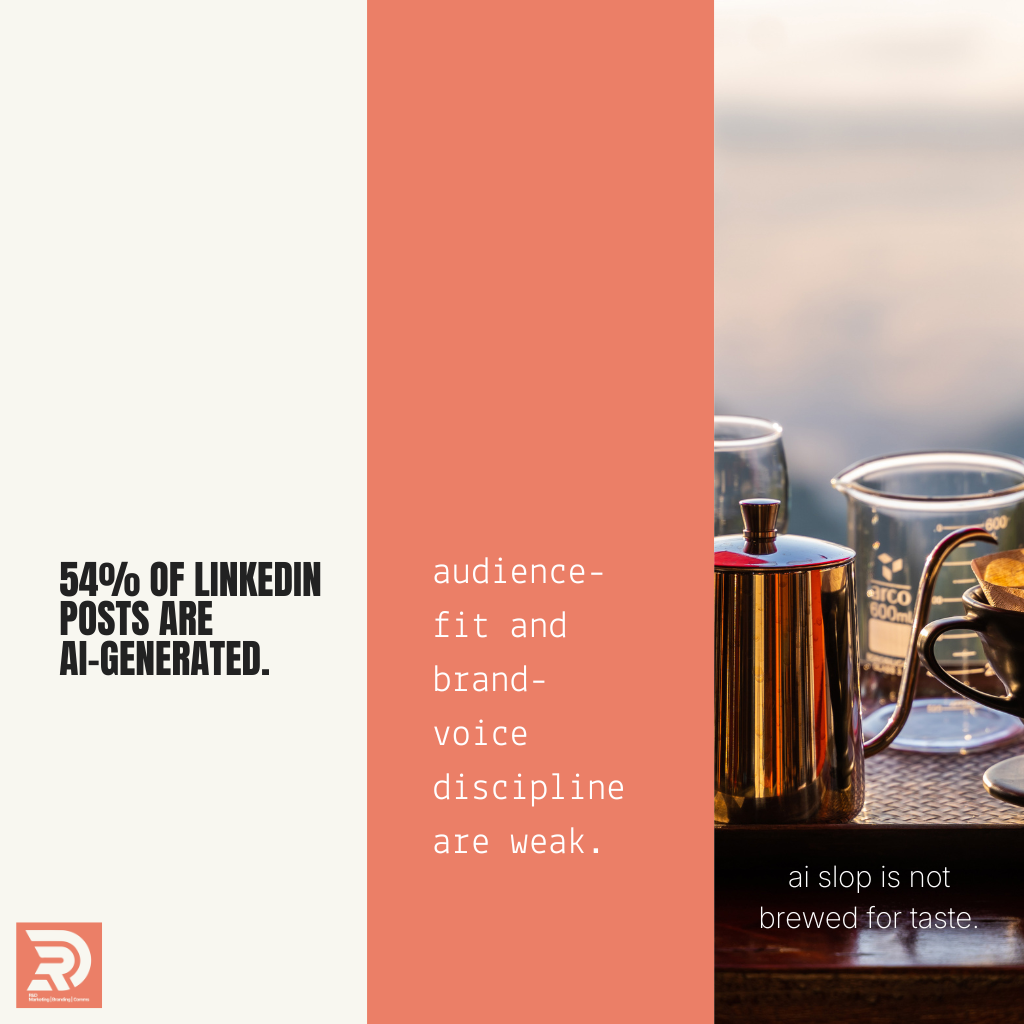
re: LinkedIn Copywriting, we tried to find a source: There’s no official LinkedIn-wide number, but the best-cited estimate suggests roughly half of sampled long-form LinkedIn posts are likely AI-generated. What we do not have is a clean stat for how much of that content is actually edited to fit an ICP, and broader B2B research suggests audience-fit and brand-voice discipline are still weak.There is not a clean, official LinkedIn-wide stat for “how much LinkedIn content is written by AI.” The most-cited estimate we found is from Originality AI: in its 2025 update, it analyzed 3,368 long-form LinkedIn posts (100+ words) from 99 influential profiles and classified 1,807 posts, or 53.7%, as “Likely AI.” Originality’s earlier study, cited by WIRED, found over 54% of longer English-language LinkedIn posts in its sample were likely AI-generated. That is useful as a directional stat, but it is not a platform-wide census. It is a detector-based estimate on a specific slice of content.There is also an important wrinkle: LinkedIn CEO Ryan Roslansky said LinkedIn’s own AI post-polishing feature was “not as popular as I thought it would be,” which suggests that if AI use is high on LinkedIn, a lot of it is likely coming from third-party tools or off-platform workflows, not just LinkedIn’s native assistant.